Why 2026 Is the Year Physical AI Left the Pilot Stage on the Factory Floor
By Critical Ventures
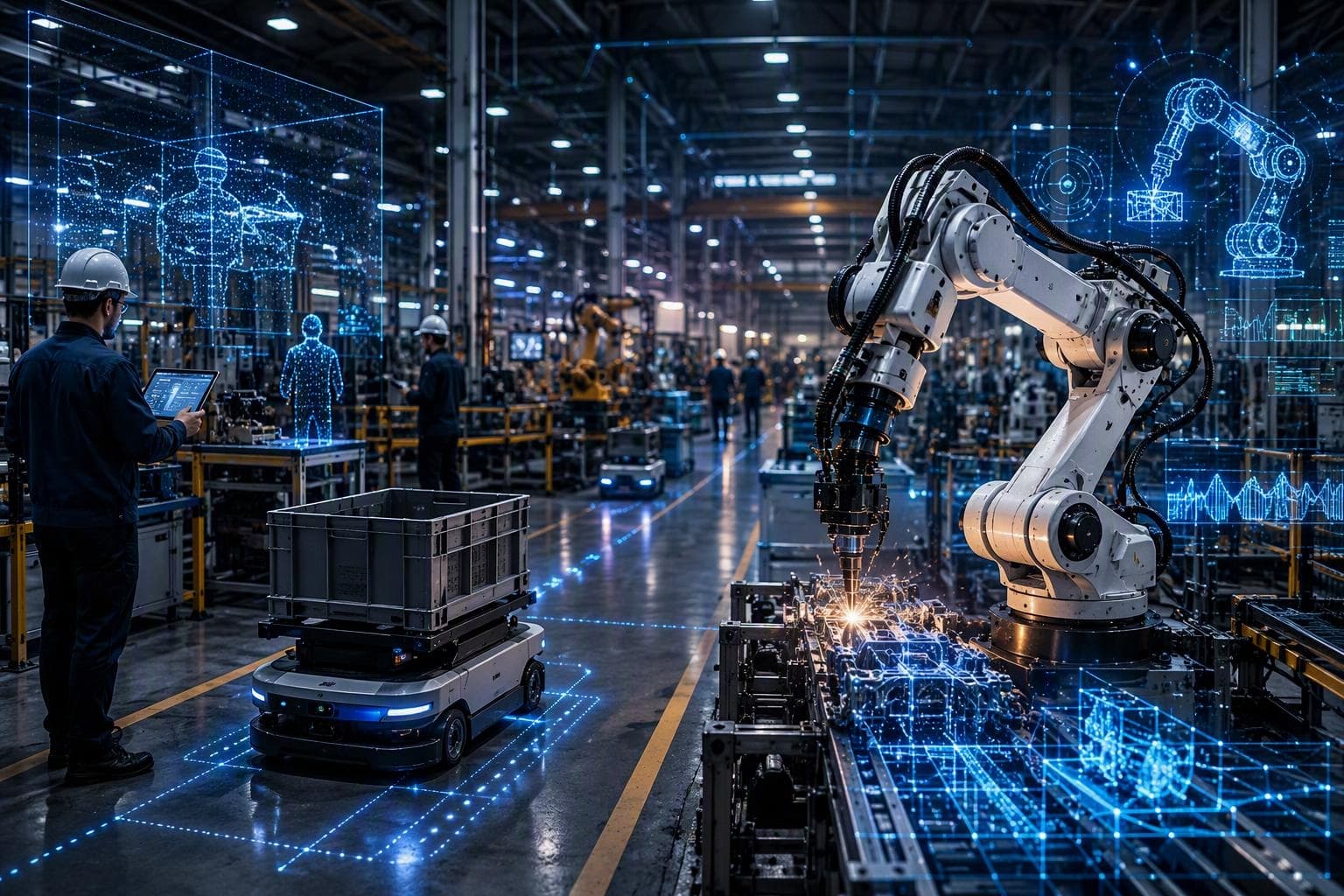
For most of the last decade, "the factory of the future" was a phrase you heard at trade shows and rarely saw on a factory floor. That's changing. Mid-2026 is shaping up to be the point where physical AI — robots and systems that learn from demonstration and sensor data rather than hand-written code — moved out of pilot programs and into full production runs.
We're writing about this now because the shift lines up closely with what we look for as investors: a real operational pain point (workforce shortages that aren't going away), a technology finally mature enough to solve it, and founders building the unglamorous infrastructure that makes it work.
The scale of the gap is the starting point. Coverage from industry outlet MarketScale this year has repeatedly cited an estimate that roughly 80% of factories in the United States operate with no robotics or automation at all — we haven't been able to independently verify that exact figure, but it's consistent with the broader picture: robot density in most economies remains low relative to the available work.
What's driving the change isn't primarily a search for cost savings. According to the International Federation of Robotics, adoption in Europe is accelerating largely because of workforce constraints rather than a push to replace workers outright — there simply aren't enough people applying for factory and logistics roles. Europe's factory automation market is estimated at around $69 billion in 2026 by at least one industry forecast, though estimates from different research firms vary meaningfully and should be treated as directional rather than precise.
Digital twins are growing alongside this. Estimates of the digital twin manufacturing market vary widely depending on the research house — figures range from roughly $33 billion up to over $47 billion for 2026, with double-digit to triple-digit compound growth projected through the early 2030s across different reports. We'd treat any single number here with caution, but the direction — rapid, broad-based adoption, with manufacturing leading other industries — shows up consistently.
The technical challenge has always been the same: real factories are messy. A part arrives half a millimeter off spec, a pallet is stacked slightly wrong, a cable snags — and traditional, scripted automation stops. That's the reason so much automation historically clustered around a narrow set of repeatable tasks like welding and palletizing, leaving the bulk of manual assembly work untouched.
What's different now is that robots and vision systems are increasingly trained by demonstration and continuous sensor feedback instead of being hand-coded for every scenario, which is what's allowing automation to move into more variable, human-dexterity-dependent work. On the hardware side, this year has also brought machines designed to work at full speed alongside people without a safety cage — a meaningful shift from the fenced-off industrial robots most people picture.
The other real barrier isn't money or even the technology — it's people who know how to integrate it. Multiple industry sources point to a shortage of automation and integration engineers as the binding constraint, not capital or hardware availability. That's arguably a bigger opportunity for software-layer companies than for robot manufacturers themselves: the winners may be the ones who make automation easier to deploy and maintain, not just the ones building the arms.
Two companies in our portfolio sit right at this inflection point.
Twinzo, a Slovak startup, has built a real-time 3D digital twin platform that connects to a factory's IoT sensors and business systems to give plant managers a live, walkable model of their operations — not a static blueprint, but a continuously updated mirror tied to real OEE, energy, and logistics data. Twinzo's own case studies point to forklift fleet reductions of up to 20% within six months and ROI in three to eight months for manufacturers who adopt the platform; these are Twinzo-published figures, and prospective customers should ask for references specific to their process. In April 2025, Twinzo partnered with Critical Manufacturing to integrate its digital twin directly with Critical Manufacturing's MES, giving operators live 3D visualization on top of existing manufacturing execution systems — a good example of digital twin technology getting embedded into existing industrial software stacks rather than replacing them.
Almetra, a Berlin-based company, takes a different angle on the same problem: computer vision aimed specifically at manual assembly work that's historically resisted automation. Almetra installs cameras at individual assembly stations, tracks hands, tools, and workpieces, and turns that into cycle-time and process data — anonymizing footage to sidestep the GDPR and EU AI Act concerns that come with monitoring people on a shop floor. It's a practical answer to a real tension in this space: manufacturers want the data automation promises, but not at the cost of treating their workforce like a monitored asset.
We're not investing in industrial automation because robots are interesting — we're investing because the operational problem (who's going to do this work) isn't solved by any other trend we can see. The founders we want to meet in this space aren't necessarily building the flashiest robot.
We're looking for teams solving the unglamorous middle layer: making automation deployable by a plant that doesn't have a robotics PhD on staff, making the data trustworthy enough for a plant manager to act on it, and doing it in a way that respects the workforce it's meant to support, not just displace.
If you're building in industrial automation, physical AI, or digital twin technology — particularly at the software and integration layer — we'd like to talk.